
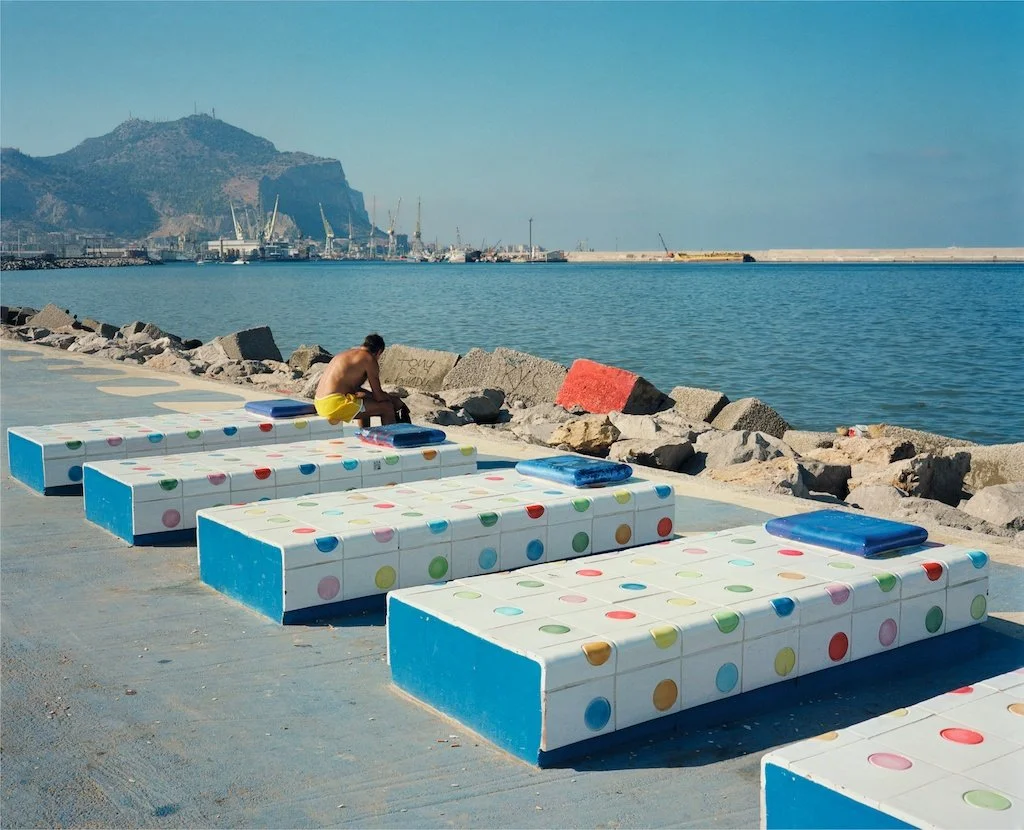
Sun Bather, Palermo, 2007. C-print. 51.9 x 58.2 inches.
In Conversation With Wim Wenders
Words by Wendy Merry, Photography by Wim Wenders
Ernst Wilhelm “Wim” Wenders is a throwback protagonist of a John Ford Western. He’s most comfortable as a sojourner: part renegade, part detective — always a lensed weapon at his chest. It’s not important to trace a line around Wenders’ creative trajectory; he hopes not to. As a director, he has derived cultish followings for the likes of Paris, Texasand Wings of Desire. He has conceived videos for U2, Stay (Faraway, So Close!), and Talking Heads. His vivid documentaries include Buena Vista Social Club and last year’s resplendent Pina, both of which the Academy of Motion Picture Arts and Sciences rewarded with nominations, the latter which he shot entirely in 3D.
Wenders is a visual prodigy born of international and generational influences. An adolescent in allied-occupied Germany, he was among the new consciousness rejecting dense Expressionism and the Godardian auteur. The result was bold, open, and personal, often steeped in anglophilic and American loner iconography: neo-noir, Monument Valley and Dennis Hopper’s ghost suburbs. His first visit to the United States was notoriously to Butte, Montana, the bosom of Dashiell Hammett’s detective novels. He has collaborated with Francis Ford Coppola and Sam Shepard. His first film, part of the Road Movie Trilogy, was dedicated to The Kinks.
Cinematography, however, was Wenders’ second medium. He began taking photos at 7 years old and by 12 had his own darkroom. Today, he shoots alone, with a Fuji Panoramic camera. He is a filmmaker known for devastating tracking shots, whose courtship with cameras blossomed during pilgrimages to cinematic locations. The results are often haunting: alien memorials possessing the palpable stillness of film sets before or after life has moved through them. His 2012 exhibition, Places, Strange and Quiet, is a caravan of ephemeral scenes spanning 30 years of travel between the United States, Japan, and Sicily.
It is pointed that landscape photography currently consumes him, that the relinquishment of authorship has led to the complete removal of self in the spirit of a more interesting truth. “With photography,” Wenders explains, “I am not the one telling the story; I am only listening.” He also reveals that each photo captures its own “merciless” narrative, the “ingredient that each photograph will survive both the [photographer] and the object of the picture.” Though he insists he is not nostalgic, Wenders’ works often convey the bittersweet ambivalence of an expatriate, wherever they take place. He allows gentle intention to emerge from spaces; speaking to the complexities of open roads, broken towns, and abandoned posts.
Wendy Merry: What is the greatest difference between creating static photography and cinema? Do you experience photographs as cinematic?
Wim Wenders: Yes, sometimes, insofar as any single image can become the starting point of an avalanche. It can release a story that might just tear you away. Not every — or any — photograph or painting does that, but some do if you let them, which totally contradicts the notion of a “static image,” of course. Photographs are only static if you, as the viewer, remain in a static mode. If you’re a bit more adventurously inclined, you manage to decipher the story that might have led to that moment — and the next one that could happen in a second. You can start to picture the eye that took the photograph and what attracted that person to stop and release the shutter and, thereby, be responsible for your watching and listening adventure.
To come to the beginning of your question: In cinema you show up with a story. You arrive at the place and make it become the “background” for what you are importing there. In which case, the places actually “freeze” and do become static. Their own stories don’t matter any more. They are now in the service of the filmmaker’s story. A strange and sometimes funny reversal happens here: Places are definitely less static in photography than in movies.
WM: Your films draw from many mediums — why do you believe cinema is still an important form?
WW: Because of where it takes place. There is this amazing process that somebody thinks up a story and prepares it and shoots it and edits it, and then somebody else makes it all his or her own. Films are our common nourishment. They don’t exist as prints; they only exist in the eyes and minds of the viewer. Even in that most privileged space for movies, the theater, we are together with others and yet so alone with that process of assimilating, identifying, recognizing, expecting, discovering, rejecting, and confirming that which we call “cinema.” That doesn’t happen anywhere else so purely and powerfully. Sometimes in churches, sometimes in concerts, yes, but that’s a different story.
WM: You have spent significant time immersing yourself into other places. What brings you home?
WW: The need to repack my suitcase. The need to get out of photography mode. The need to belong to something familiar for a while. I used to go on these photographic journeys strictly on my own; I couldn’t have anybody with me. Now my wife and I travel together. It works miraculously. We have breakfast together, then we split. Donata is taking pictures of people, looking to find and meet them, follow them, spend time with them. And she shoots in black and white. I am looking for places, and when I find one that I like, I spend time there and often wait until I’m alone, until people have left the frame — and I can only shoot in color. In the evening, we get back together, full of what we’ve seen, whom we’ve met, where we’ve been. Often we only actually see the other’s adventures when we get home and develop the film and look at the contact sheets. I can’t believe that Donata met all these people, and she can’t believe the places I’ve been. Yet we were in the same city or landscape.
WM: If photography and cinema were human entities, how would you presently describe your relationship with each?
WW: Photography would be my old lonesome friend who doesn’t do e-mails and doesn’t answer his phone. But when you do locate him, you have the greatest time together. And cinema is my extremely busy other best friend who is always on the move and does many things at once, so you really have to force him to pay attention and concentrate. But when he finally does, it is invigorating.
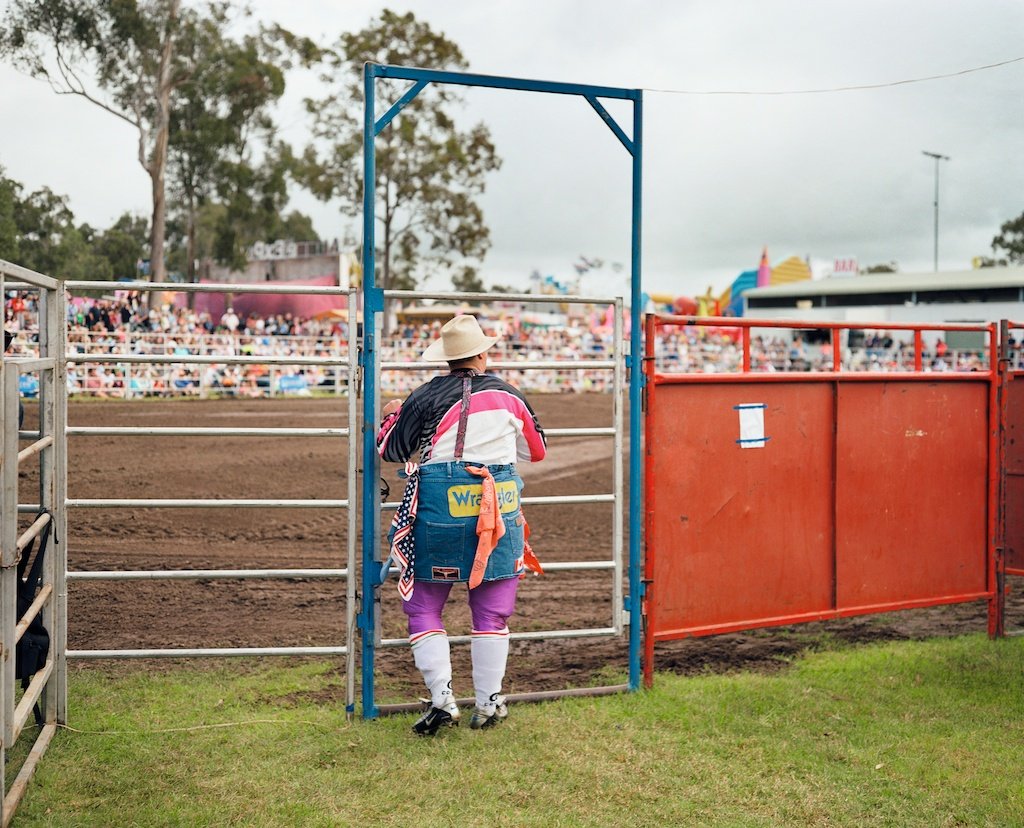
Rodeo Clown, Brisbane, 2006. C-print. 51.9 x 58.2 inches.
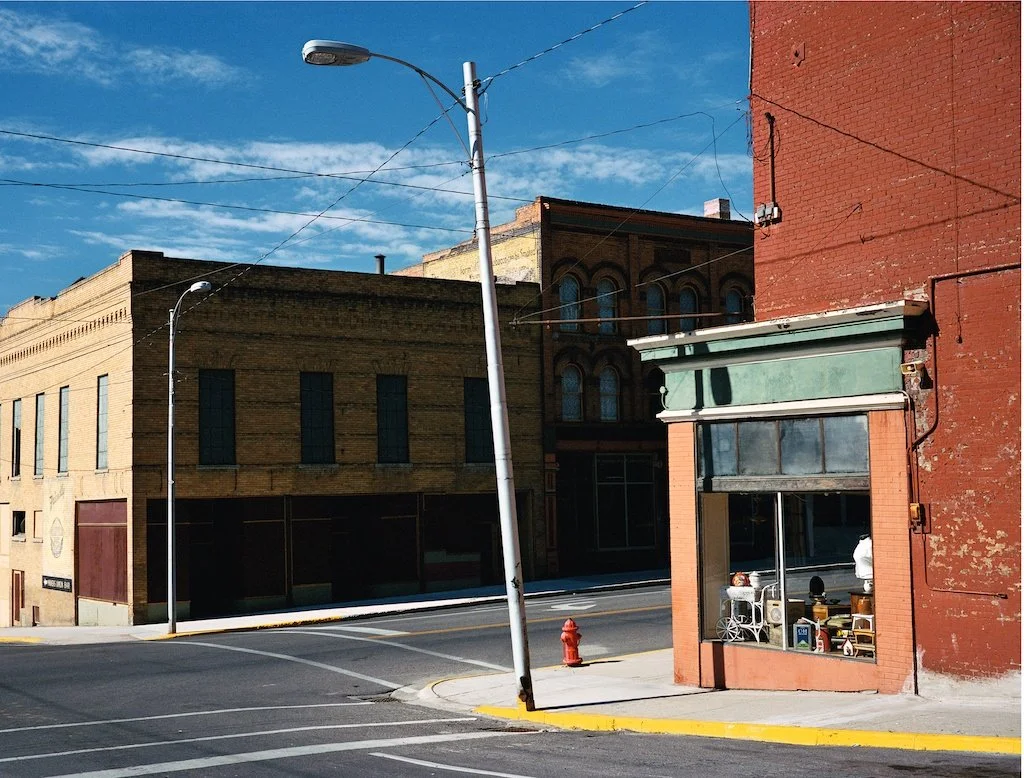
Street Corner in Butte, Montana, 2003. C-print. 73.2 x 88.1 inches.
WM: Do you think photography has altered your vision and expectations as a film director? Would the reverse be true?
WW: Photography and filmmaking have a common source for me: They come from painting. I learned more from the history of painting than from the respective histories of photography or cinema. Those have a common reference, so to speak, for me. “Framing” is an essential part of my work, as a filmmaker and as a photographer. Sometimes I think it is the most crucial element in both crafts. And they, indeed, instruct each other in that respect. Framing in film is often fluid, as the shots are moving — and, in that fluidity, frames emerge that you could not have thought of but that have their own power, mainly because you didn’t conceive of them but found them. Anyway, I’m much more a “finder” than an “inventor.” Imposing the frame is already quite an intrusion.
WM: You have been vocal that it is a mistake to over-conceptualize; what is the connective tissue across Places, Strange and Quiet, and at what point in the creation process did it emerge?
WW: I only found out going through a lot of my prints and trying to find something in common for an exhibition that I, obviously, was attracted to places that had something in common. When I spelled it out, it became a title I liked. There was no concept whatsoever guiding the taking of these photographs. There were journeys to different parts of the world, with the realization, in hindsight, that I had a tendency to find these places that were indeed quiet and lost, and definitely strange — like I was on some inbuilt radar. That “navigation system” in my brain cannot be confounded with a “conceptualization.”
WM: Which medium has most viscerally informed your travel experiences?
WW: Music, definitely. Followed on its heels by literature. I felt or anticipated Los Angeles through [Raymond] Chandler, San Francisco though [Dashiell] Hammett, and the South through [William] Faulkner long before I ever arrived in any of those places. Movies didn’t have that effect — to prepare me for a landscape. All the Westerns I’d ever seen — by Raoul Walsh, Anthony Mann, John Ford or Sam Peckinpah — did not prepare me a bit for driving through the West.
WM: What music, then, would serve as companion to Places, Strange and Quiet.
WW: It could very well be my iPod in random mode, playing from its “driving” playlist or any other favorites. The thing with music is that it must never be too much on the nose to serve as a companion to a picture or a view. It must not explain or interpret. It should open up new possibilities, clear the air, create connections you didn’t imagine before.
WM: What is your favorite strange and quiet place?
WW: The desert. Any desert or suburbs — any no man’s land.
WM: You have said your camera is a listening device. Looking through the images that comprise Places, Strange and Quiet, what do you hear?
WW: A cacophony of voices, speaking in foreign languages and tongues. But behind all the discombobulated stories and weird accounts of these places there is a common message: Look at us! We’re maybe hard to find but one thing is for sure: We’re all unique! The world offers an absolutely stunning multitude of views, of which you can only fathom a tiny percentage. The world is undiscovered.
WM: As an explorer of film, photography and art history, how would you like your work to be synthesized by a historian?
WW: “He witnessed his time.” Damn, that sounds like an inscription on a gravestone. Who knows how all our work today will look in the future. “He didn’t have a clue,” might be the verdict. Or “He would have better fit into the German Romanticism of the 19th century.” Or “He was ahead of his time.” That is something I witness myself in my work and that of my friends: At times you are lagging behind, and sometimes you are a bit ahead. It’s something you can’t really decide or control. Also, how a film or photograph ages is luckily out of our control.
WM: What surprises you most about your career trajectory?
WW: That it made sense — or better, makes sense. It amazes me sometimes how one thing leads to another and how it all strikes me as somehow congruent. Somebody else might call it “consistently inconsistent.” To me, it definitely makes sense. Then again, I’m a born optimist; I believe in a god who watches us. No wonder things make sense!
Originally published in Dossier Journal No. 9, 2012.