
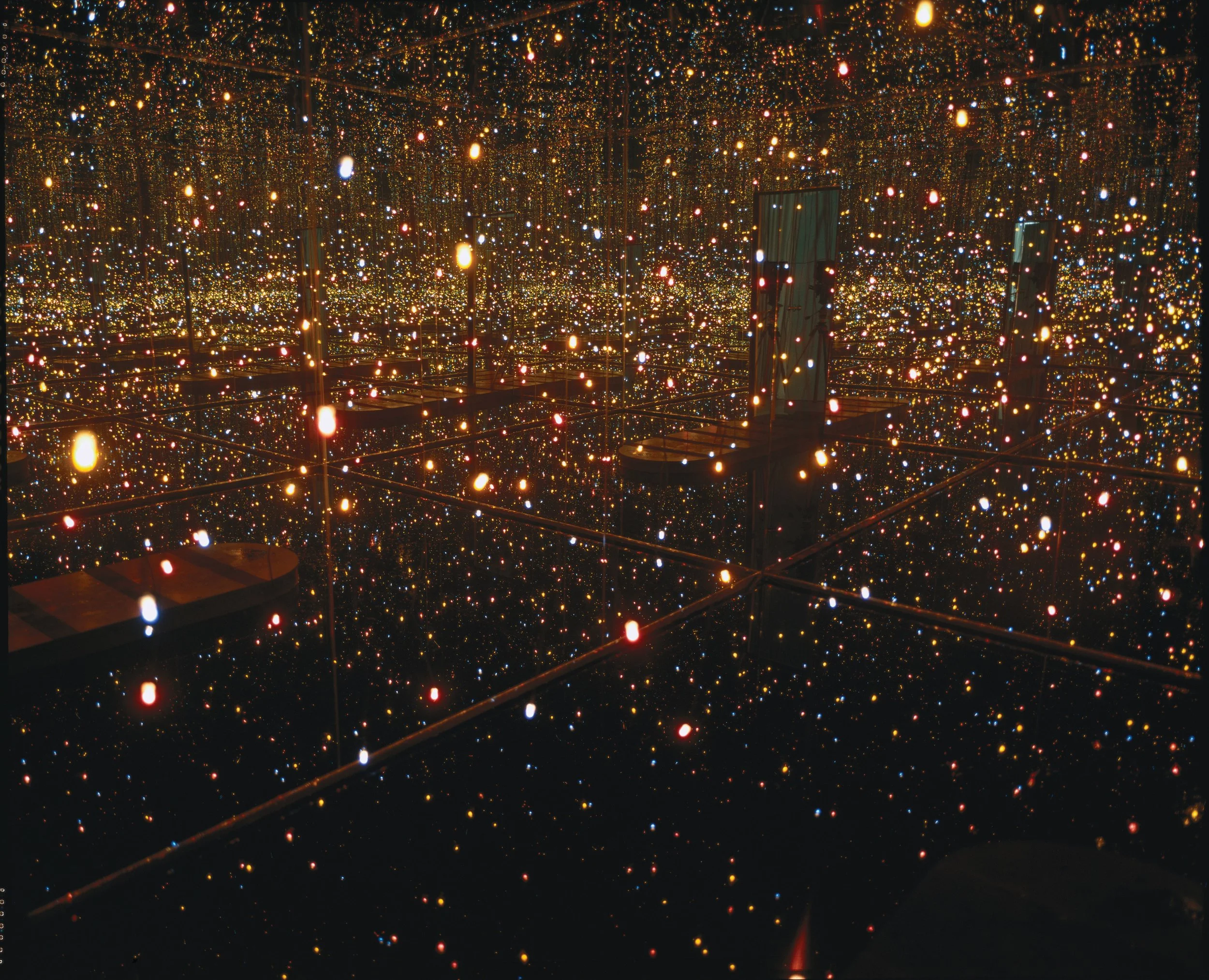
Fireflies on the water, 2002. Mirror, plexiglass, 150 lights and water. Overall: 111 x 144 1/2 x 144 ½ inches. Whitney Museum of American Art, New York; purchase, with funds from the Postwar Committee and the Contemporary Painting and Sculpture Committee and partial gift of Betsy Wittenborn Miller 2003.322a-tttttttt. © Yayoi Kusama. Photograph courtesy of Robert Miller Gallery.
In Conversation with Yayoi Kusama
Words by Zac Bayly, Photography courtesy of Yayoi Kusama
There’s something innately paradoxical about the life and work of polka dot-obsessed Japanese artist Yayoi Kusama: She explores the infinite through the intimate. On one hand, she claims that her artworks — repetitious polka dot-covered sculptures, paintings, and installations; and constellation-inspired mirrored rooms that give the impression of endlessness — represent something very personal (the hallucinations that plague her) and that the process of creating them acts as a sort of therapy. On the other hand, her patterned pieces seem factory-produced, and the reality is that almost anybody could reproduce a Kusama piece with little technical difficulty. Yet, despite the simplicity and universality of her motif, Kusama is inextricably present in her artwork.
She is considered a protagonist of the New York City avant-garde movement of the 1960s, having organized the city’s iconic Body Festivals and exhibited alongside artists such as Andy Warhol and Claes Oldenburg, but her work is universal. Her boldly colored polka dots have been plastered across everything from trees to naked bodies to beach balls to Louis Vuitton’s latest accessory line. Naturally, appropriating the polka dot, making it synonymous with her name — she’s widely known as the “princess of polka dots” — has taken considerable persistence, which has led critics and a number of her contemporaries to conclude that she’s extremely savvy, a public relations mastermind rather than a tortured soul.
This paradox extends into her recognized persona. Kusama is a reclusive enigma, who has voluntarily resided at the Seiwa Hospital for the Mentally Ill since 1977. However, much of her earlier life is detailed explicitly in her autobiography, Infinity Net: The Autobiography of Yayoi Kusama. In interviews she remains poker-faced, divulging little about her personal life. At the same time, the concepts she’ll happily discuss — her mental health and its influence on her art, and the overwhelming sense of the infinite that she feels threatens to obliterate her — could hardly be more personal.
Take for example Kusama’s 1954 painting “Flower (D.S.P.S),” about which she stated, “One day I was looking at the red flower patterns of the tablecloth on a table, and when I looked up I saw the same pattern covering the ceiling, the windows, and the walls, and finally all over the room, my body, and the universe. I felt as if I had begun to self-obliterate, to revolve in the infinity of endless time and the absoluteness of space and be reduced to nothingness. As I realized it was actually happening, and not just in my imagination, I was frightened. I knew I had to run away, lest I should be deprived of my life by the spell of the red flowers. I ran desperately up the stairs. The steps below me began to fall apart, and I fell down the stairs, straining my ankle."
So, has Kusama finally achieved a level of internal peace through solitude and the therapeutic repetition of painting spots? And, also, how could she hope to? As Albert Einstein once quipped, “Insanity is doing the same thing over and over again and expecting different results.” To quote schizophrenic sci-fi novelist Philip K. Dick, whose work also explored identity and perception, “The problem with introspection is that it has no end.” There is no end in sight for Kusama, who — despite being 83 years old — is perhaps more famous, relevant, and indeed prolific than ever before. She has had solo exhibitions at major galleries around the world this year, notably including Tate Modern and the Whitney Museum of American Art.
Zac Bayly: What is life like at your residence? Could you tell us about a typical day, or a specific day (like the day that you answer these questions)?
Yayoi Kusama: I had a meeting about the new building for my foundation, and after that I painted new paintings for hours.
ZB: I hope this is not too personal a question, but could you describe a recent hallucination and explain how it influenced you whilst creating a particular piece of art
YK: Since my childhood, I’ve been suffering from hallucinations. However after I met a good psychiatrist, my condition got better. But I’ve made many works based on my hallucinations. I just kept sketching whenever I saw hallucinations.
ZB: Where does the border of reality and fantasy reside, and do you feel bound by the confines of reality?
YK: No, I don’t feel bound by the confines of reality.
ZB: Over the years, you have described your work as "art medicine." Can you explain how creating new works is therapeutic, and how it differs from the time when you're not creating something?
YK: Usually art production moderates my mood, and I hope it also makes my physical condition get better. I keep on working from morning till night and am absorbed in art production so much that I forget my meals.
ZB: Does creating art make you happy? Is there anything else in life that brings you a sense of joy, such as staring at the stars or going to the beach? Your work often reminds me of infinite stars or grains of sand.
YK: I’ve never thought if art makes me happy or not, but I don’t have anything else. Art is everything for me. I am pleased to have many fans and to be invited to hold solo exhibitions or international exhibitions all over the world.
ZB: How have you maintained your passion and attention for polka dots over decades?

Self-Obliteration No. 3., 1967. Watercolor, ink, pastel and photocollage on paper. 15 7/8 x 19 13/16 inches. Collection of the artist. © Yayoi Kusama. Image courtesy of Yayoi Kusama Studio Inc.; Ota Fine Arts, Tokyo; Victoria Miro Gallery, London; and Gagosian Gallery, New York.

I Want to Live Honestly, Like the Eye in the Picture, 2009. Synthetic polymer on canvas. 51 5/16 x 63 3/4 inches. Collection of the artist. © Yayoi Kusama. Image courtesy of Yayoi Kusama Studio Inc.; Ota Fine Arts, Tokyo; Victoria Miro Gallery, London; and Gagosian Gallery, New York.
YK: I get mountainous energy from creating works with polka dots and infinity nets motifs — so much that I never get tired.
ZB: How has your relationship with them changed over the years?
YK: My passion has never changed; I am desperate to create more and more works.
ZB: How do you feel about stripes?
YK: I may paint it, but I have never thought about it, particularly.
ZB: In what way does your visual art correspond with your work as a novelist and poet?
YK: I have created paintings, sculptures, movies, fashions, and also many poems about infinity polka dots and universal nets. There is no boundary between visual art works and literary work. I adopt everything that I’m interested in.
ZB: What are the shared themes?
YK: I hope the world becomes a peaceful place. A world of no terrorism, nor war. I have been sending the message “love forever” through my art.
ZB: You have called yourself an "obsessive artist." Do you have any recent obsessions?
YK: I adopt these obsessions into my art.
ZB: Who have been the three most influential people in your life, and why?
YK: I was never influenced by someone else [because] I believe in my own art.
ZB: What are you most proud of and what do you most regret?
YK: I am proud that I am constantly building up a splendid development of my creation. I don’t have any regrets [because] I take responsibility for my life.
ZB: What is the most misunderstood aspect of your art?
YK: My art is misunderstood in many respects. But with my proud philosophy of life, they all change into peace and happiness.
ZB: Do you have a dream project that you are yet to create?
YK: My life is about changing the world of a changeless hymn of life with the power of art.
ZB: What do you see as the most important artwork of your career?
YK: All of my works are equally important. I have lived till now in awe of nihilism and the infinite universe — and with a faith of wanting to uphold their mysteriousness.
ZB: What do you love and hate most in the world?
YK: I am interested in everything, and I admire all the mysteries of the universe.
ZB: How would you like to be remembered?
YK: I hope that Yayoi Kusama’s art, which took some decades to establish, would forever stay in people’s memory as the philosophy of my life.
Originally published in Dossier Journal No. 10, 2012.